A more beautiful smile — without grinding down your natural teeth. Here's what no-prep and minimal prep porcelain veneers can do, and why the ceramist behind them matters as much as the dentist.
·
Moritis & Shin Dentistry, Downtown Seattle
·
7 min read
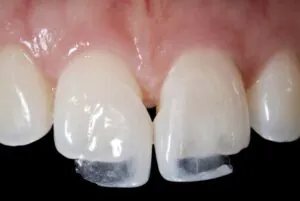
When most people picture veneers, they picture the older version — teeth shaved down aggressively to make room for thick porcelain shells, a procedure that permanently alters healthy tooth structure and requires local anesthesia for every step. That approach still exists, and it's still appropriate for certain cases. But it's no longer the only option, and for many patients, it's not the best one.
At Moritis & Shin Dentistry, we offer no-prep and minimal prep porcelain veneers — ultra-thin restorations that preserve your natural tooth structure while transforming your smile. What sets our results apart is the ceramist behind the work: an Oral Design master ceramist based in Switzerland and Seoul, crafting each veneer by hand to a standard that simply isn't available through most dental labs.
This guide explains what no-prep and minimal prep veneers are, who they're right for, and what makes the difference between a veneer result that looks stunning and one that looks like you're wearing veneers.
Quick answer
What are no-prep and minimal prep veneers?
No-prep veneers are ultra-thin porcelain shells — typically 0.2 to 0.5mm — bonded directly to the front surface of the teeth without removing any natural tooth structure. Minimal prep veneers involve a very slight reduction within the enamel layer only, preserving the underlying tooth completely. Both approaches are reversible or minimally invasive alternatives to traditional veneers, and when crafted by a master ceramist, they produce results that are virtually indistinguishable from — and often superior to — conventional veneers in the right candidate.
Interested in veneers? Start with a consultation.
Moritis & Shin Dentistry offers no-prep and minimal prep veneer consultations in Downtown Seattle. We'll evaluate your smile, walk you through your options, and show you what's possible — before you commit to anything. In-network with Delta Dental PPO, Cigna PPO, Aetna PPO, and Regence PPO. Financing available with no credit score impact.
✓ Delta Dental PPO
✓ Cigna PPO
✓ Aetna PPO
✓ Regence PPO
The problem with traditional veneers — and why less preparation is better
Traditional porcelain veneers require the dentist to remove 0.5 to 1.5mm of tooth structure from the front surface of each tooth — permanently — to create space for the veneer. Once that enamel is gone, it doesn't grow back. The teeth require porcelain coverage for life, and any future replacement veneers involve the same permanently altered tooth structure.
For decades, this was the only way to achieve the thickness and opacity needed for porcelain to look natural. Modern ceramics, adhesive technology, and master-level craftsmanship have changed that entirely.
Today's ultra-thin feldspathic porcelain veneers can be fabricated at 0.2 to 0.3mm — thinner than a contact lens — with translucency and light-reflecting properties that mimic natural enamel precisely. Bonded with modern adhesive systems, these restorations achieve exceptional strength without requiring the underlying tooth to be reduced at all in many cases. The result: a transformed smile with your natural teeth preserved underneath, intact and healthy.
No-prep veneers vs. minimal prep veneers — what's the difference?
| No-prep veneers | Minimal prep veneers | Traditional veneers | |
|---|---|---|---|
| Tooth reduction | None | 0.2–0.5mm (enamel only) | 0.5–1.5mm |
| Reversibility | Reversible | Minimally invasive | Irreversible |
| Anesthesia needed | Usually none | Rarely needed | Always required |
| Temporaries needed | No | Rarely | Always |
| Veneer thickness | 0.2–0.5mm | 0.3–0.7mm | 0.5–1.5mm |
| Material | Feldspathic porcelain | Feldspathic or pressed ceramic (e.max) | Pressed ceramic or porcelain |
| Natural tooth preserved | 100% | 95–99% | Significantly reduced |
The materials: feldspathic porcelain and pressed ceramic
The material choice in veneer work is not merely technical — it directly determines how natural the final result looks, how durable it is, and how thin it can be made. At Moritis & Shin, we work with two primary materials for no-prep and minimal prep cases:
Feldspathic porcelain — the gold standard for no-prep veneers
Feldspathic porcelain is the most optically sophisticated ceramic material in dentistry. Its layered, hand-stacked fabrication process — done entirely by the ceramist rather than a machine — allows for the reproduction of the subtle internal color variation, translucency gradients, and light-scattering properties of natural enamel. When you look at a beautifully crafted feldspathic veneer in natural light, it doesn't look like a restoration. It looks like a tooth — because it behaves like one optically.
Feldspathic porcelain can be fabricated as thin as 0.2mm, making it the material of choice for true no-prep veneers. Its lower strength compared to pressed ceramics is offset by the exceptional bond strength of modern adhesive systems and the fact that, at such thin dimensions, the bonded unit (veneer + adhesive + tooth) behaves as a single structural whole.
Best for: no-prep cases, patients with good existing tooth color who want subtle refinement, cases requiring maximum translucency and natural optical behavior.
Pressed ceramic (lithium disilicate / e.max) — for minimal prep and stronger coverage needs
Lithium disilicate pressed ceramics — most commonly known by the brand e.max — offer significantly higher flexural strength than feldspathic porcelain while maintaining excellent optical properties. They are pressed rather than hand-layered, giving them more uniform structural integrity. For cases requiring slightly more coverage, better masking of underlying tooth color, or additional strength, pressed ceramics offer an excellent balance of aesthetics and durability.
Pressed ceramic veneers typically require a minimal prep of 0.3 to 0.5mm to achieve optimal aesthetics — still dramatically less than traditional veneer preparation, and still entirely within the enamel layer in most cases.
Best for: minimal prep cases, patients needing more color masking, cases involving slight crowding or shape correction, patients who want additional long-term durability.
What makes our veneers different: the Oral Design master ceramist
In veneer dentistry, the ceramist is not a support role — they are half the team. A veneer is only as good as the person who fabricates it, and the difference in skill between a standard dental lab technician and a master ceramist is not incremental. It is categorical.
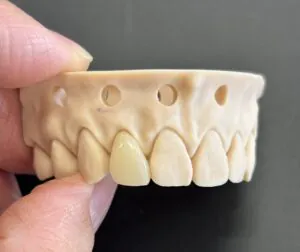
At Moritis & Shin Dentistry, our veneers are crafted by a master ceramist affiliated with Oral Design — the elite international network of dental ceramists founded in Zurich, Switzerland, with over 130 members across the world, known for setting the standard in cosmetic ceramic artistry. Our ceramist works from laboratories in Switzerland and Seoul, fabricating each veneer entirely by hand using techniques refined over decades of high-level aesthetic dentistry.
What this means in practice:
| Hand-layered ceramic | Each veneer is built layer by layer by hand — not milled by a machine. This is what produces the internal color depth and translucency variation that makes a veneer indistinguishable from a natural tooth. |
| Individualized for each patient | Your veneers are not selected from a catalog. The ceramist studies photographs of your teeth, your skin tone, your facial proportions, and your smile design to create restorations specific to you. |
| International standard, local care | You receive veneer work at a standard typically found only at top cosmetic practices in major international cities — delivered at our Downtown Seattle office, with in-network PPO insurance accepted. |
| Close dentist-ceramist collaboration | Dr. Shin works in direct communication with the ceramist throughout every case — sharing digital records, photos, and feedback at each stage. The result reflects both clinical precision and ceramic artistry working together. |
Most dental veneers in the US are fabricated by commercial dental labs using CAD/CAM milling — fast, efficient, and standardized. Beautiful results at this level require something different: a master ceramist who understands optical physics, ceramic chemistry, and the art of creating a restoration that doesn't look like a restoration. That is what Oral Design represents, and it is what our patients receive.
See what's possible for your smile.
We use digital smile design technology to show you a preview of your veneer result before any treatment begins. Book a consultation at Moritis & Shin Dentistry in Downtown Seattle — in-network with Delta Dental PPO, Cigna PPO, Aetna PPO, and Regence PPO. Financing available with no credit score impact.
Who is a good candidate for no-prep or minimal prep veneers?
Not every patient is a candidate for no-prep veneers — and an honest assessment of candidacy is the most important service a cosmetic dentist can provide. Here's how we evaluate each case:
| Ideal for no-prep veneers | Better suited for minimal prep | May need traditional veneers or other treatment |
|---|---|---|
| Small or narrow teeth with space to add volume | Mild crowding or shape irregularities | Severely dark or discolored teeth needing full opacity |
| Mild spacing or gaps between teeth | Moderate discoloration needing more masking | Significant bite problems or heavy grinding (bruxism) |
| Teeth with good color wanting subtle whitening and refinement | Slightly protruding or bulky teeth needing slight reduction | Severe alignment issues better addressed with Invisalign first |
| Chipped or worn edges needing length restoration | Teeth that are already slightly small or short | Active gum disease (must be treated first) |
| Patients who want reversibility preserved | Patients wanting a more dramatic shape change | Patients who are not yet ready for permanent restorations |
The consultation appointment is where we determine which column your case falls into — and sometimes a combination approach makes sense. For example, patients with mild crowding often benefit from a short Invisalign phase first, followed by no-prep veneers, producing a result that neither treatment could achieve alone as beautifully.
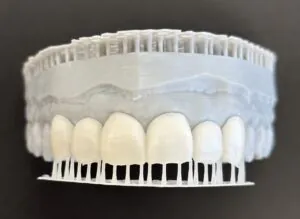
The veneer process at Moritis & Shin — what to expect
| 1 |
Smile design consultation We evaluate your teeth, gum line, facial proportions, and aesthetic goals. Digital photographs and records are taken. We discuss what you want to change and what's achievable, and show you a digital preview of potential outcomes. |
| 2 |
Digital records Your photographs, digital scans, shade records, and smile design parameters are sent directly to our Oral Design master ceramist in Switzerland or Seoul. The ceramist begins the design and fabrication process with complete patient-specific information. |
| 3 |
Preparation appointment (if minimal prep) For minimal prep cases only — a very slight enamel reduction is performed, typically without anesthesia. For true no-prep cases, this appointment is skipped entirely. Impressions or a digital scan is taken and sent to the lab. |
| 4 |
Try-in When the veneers arrive from the lab, we try them in using a glycerin try-in gel so you can see exactly how they look before anything is permanently bonded. Adjustments can be made and sent back to the ceramist at this stage if needed. Nothing is permanently placed without your approval. |
| 5 |
Bonding The veneers are bonded using high-strength dental adhesive and light-cured resin cement. For no-prep cases this is entirely pain-free and often requires no anesthesia. The appointment typically takes 1.5–2 hours for a full smile set. |
| 6 |
Review and long-term care A follow-up appointment confirms everything looks and feels right. We discuss long-term care, including night guard recommendations for patients who clench or grind, and scheduled maintenance visits to keep your veneers performing beautifully for years to come. |
How long do no-prep and minimal prep veneers last?
A 2022 clinical study evaluating feldspathic ceramic veneers using minimally invasive and no-prep techniques over a seven-year period found an overall survival rate of 91.77% — comparable to survival rates reported for traditional veneers in the same timeframe. A 2025 retrospective study of ultra-thin no-prep zirconia veneers found a 99.5% survival rate at 24 months with no debonding events recorded.
The longevity of your veneers depends on three factors: the quality of the fabrication (ceramist skill), the precision of the bonding procedure (dentist skill), and how you care for them at home. With proper maintenance — regular cleaning, avoidance of excessive force, and wearing a night guard if you grind — well-made no-prep and minimal prep veneers can last 10–15 years or longer.
What do veneers cost in Seattle — and does insurance cover them?
Porcelain veneers are generally considered a cosmetic procedure and are not covered by dental insurance. However, there are important nuances:
When insurance may contribute: If a veneer is being placed on a tooth that also has structural damage — a large crack, significant decay, or a fractured existing restoration — the structural portion of the treatment may qualify for coverage under your restorative benefit. We review each case and apply insurance benefits wherever they legitimately apply.
Cost range in Seattle: No-prep and minimal prep veneers crafted by a master ceramist represent the premium end of cosmetic dentistry — reflecting the skill of both the dentist and the ceramist, the quality of the ceramic material, and the individualized fabrication process. We provide a detailed cost breakdown during your consultation, before you commit to anything.
Financing: We offer in-house payment plans and interest-free financing with no credit score impact, available to all patients. Many patients spread veneer treatment comfortably over 12–24 months with zero additional cost.
Ready to see what's possible for your smile?
A veneer consultation at Moritis & Shin Dentistry starts with a digital smile preview — so you can see potential results before committing to anything. Located in Downtown Seattle, serving Capitol Hill, Belltown, South Lake Union, and Pioneer Square. Financing available with no credit score impact.
Frequently asked questions about veneers in Seattle
What are no-prep veneers?
No-prep veneers are ultra-thin porcelain shells — typically 0.2 to 0.5mm — bonded directly to the front surface of the teeth without removing any natural tooth structure. They are entirely reversible and often require no anesthesia. When crafted by a master ceramist using high-quality feldspathic porcelain, no-prep veneers produce results that are virtually indistinguishable from natural teeth.
Are no-prep veneers as good as traditional veneers?
For the right candidate, yes — and in some ways better, because your natural teeth are preserved intact underneath. The key variables are candidacy (not every case is suitable for no-prep) and ceramist skill (the optical quality of a hand-layered feldspathic veneer from a master ceramist surpasses most conventional veneer work). The consultation determines which approach is right for your specific situation.
How long do porcelain veneers last in Seattle?
Clinical studies on minimally invasive and no-prep feldspathic veneers show survival rates of over 91% at seven years — comparable to traditional veneers. With proper care, including regular dental maintenance and a night guard if you grind, well-made porcelain veneers can last 10–15 years or longer. The quality of the ceramist and the bonding procedure are the most significant factors in long-term performance.
What is Oral Design?
Oral Design is an elite international network of master dental ceramists founded in Zurich, Switzerland, with over 130 members worldwide. The organization is known for setting the highest standard in cosmetic ceramic artistry — emphasizing hand-fabricated, individualized restorations that replicate the optical properties of natural teeth. Moritis & Shin Dentistry works with an Oral Design master ceramist based in Switzerland and Seoul for all veneer cases.
Do veneers hurt?
No-prep veneers typically require no anesthesia and cause no pain during or after the procedure. Minimal prep veneers involve a very slight enamel reduction — usually painless or requiring only topical anesthesia. Traditional veneers require local anesthesia due to more significant tooth reduction. Post-procedure sensitivity, if any, is typically mild and temporary.
Does dental insurance cover veneers in Seattle?
Veneers are generally considered a cosmetic procedure and are not covered by dental PPO plans. However, if a veneer is placed on a structurally compromised tooth, a portion of the treatment may qualify under restorative benefits. We review each case at your consultation and apply insurance coverage wherever it legitimately applies. Financing options including interest-free payment plans are available for all patients.
The bottom line
No-prep and minimal prep veneers represent the most conservative, most reversible path to a transformed smile available in modern cosmetic dentistry. When your natural teeth are preserved, when the ceramist is working at a master level, and when the design is built around your individual facial proportions — the result isn't just a better smile. It's a better version of your own smile.
If you've been thinking about veneers and wondering whether they require you to sacrifice your natural teeth — the answer, for many patients, is no. The consultation is where we find out if you're one of them.
Moritis & Shin Dentistry — Downtown Seattle
509 Olive Way, Suite 1520, Seattle WA 98101
No-prep & minimal prep veneers · Oral Design master ceramist · Digital smile preview before you commit
In-house payment plans and interest-free financing — no credit score impact
Serving Downtown, Capitol Hill, Belltown, South Lake Union & Pioneer Square
✓ Delta Dental PPO
✓ Cigna PPO
✓ Aetna PPO
✓ Regence PPO